Canthal Tilt and PSL Rating: Why Your Eye Angle Defines Your Tier
Last updated: May 21, 2026
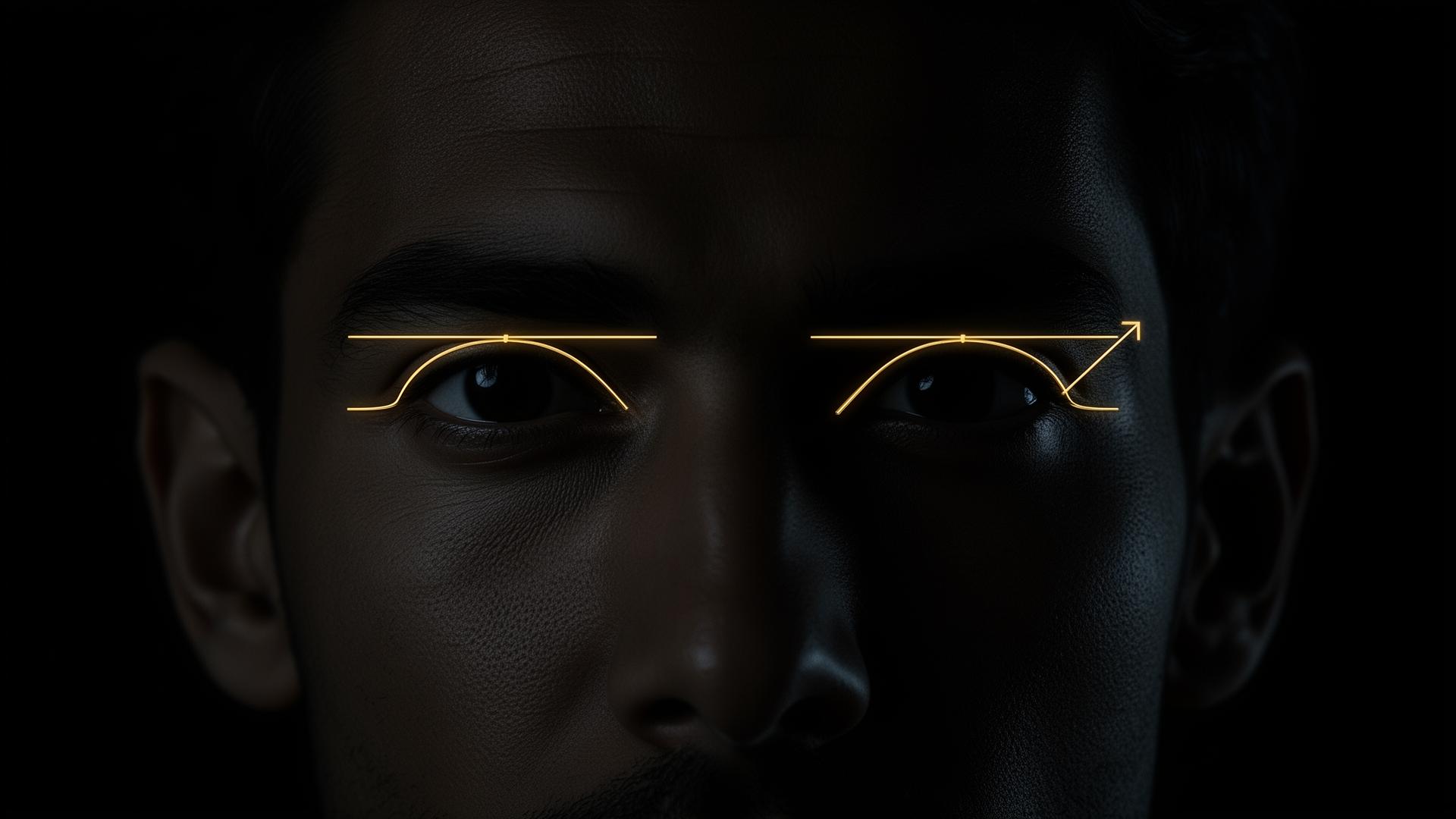
Canthal Tilt refers specifically to the angle measured from the medial canthus to the lateral canthus. A positive canthal tilt is when the outer corner (lateral canthus) is higher than the inner corner (medial canthus). A more positive canthal tilt is associated with having 'hunter eyes,' dominance, and a higher positive stoplist (PSL) score. A more negative canthal tilt is when the outer corner (lateral canthus) is lower than the inner corner (medial canthus). It has the appearance of prey eyes and is the most common and impactful 'fail' when scoring on the PSL. It has been said that the average male has a canthal tilt of +1° to +3°, with +5° and above is distinctly hunter, and anything below 0° is considered a detriment to the eye area and overall PSL rating. Some factors that can affect canthal tilt include grooming techniques, body fat, and sleep. However, once again, the facial structure is permanent and will not be changed without surgical intervention.
There are many who have contended with the so-called "looksmaxxing" communities online. You'll almost always hear the term "hunter eyes" which are arguably one of the elite aesthetics to have. One of the main driving factors to having "hunter eyes" comes down to one specific, easily measureable value: canthal tilt. It's not even about the colour of the eyes, or the size, or the shape. It comes down almost entirely to the angle of the eye and is arguably one of the most significant determinants to the PSL scoring.
This article describes what canthal tilt means, the importance of canthal tilt in the ranking framework, what the population data reveals, and what actions you can take to change your canthal tilt score.
What canthal tilt actually measures
Canthal tilt describes the degree of slant of the eye's outer and inner corners.
As part of the PSL score, a positive canthal tilt denotes the outer eye corner sits above the inner eye corner.
Measurement is done from a straight-on photograph with the head level — not tilted, not angled. The line is drawn from the innermost point of the eye opening to the outermost point. The angle is measured relative to a true horizontal.
What the PSL framework actually says about canthal tilt
Neutral canthal tilt refers to both corners of the eye being level, in which case the eye appears horizontal.
In negative canthal tilt, the outer corner of the eye is lower than the inner corner, the eye appears droopy, and is associated with being tired and having a low PSL ranking.
A +5° or -3° canthal tilt on the score can shift a PSL rating by 0.5 to 1 point in community assessments, so this is not a minor component of the overall score.
Positive, negative, and neutral canthal tilts
Positive canthal tilt (+3° to +10°): The outer corner of the eye has a noticeable upward slant. This gives a more intense, alert, and dominant appearance. The eye appears to be "resting sharp" which is a more neutral look than sad. This is commonly known as the "hunter" look since Chadlite ranking and above always exhibit this feature.
Neutral canthal tilt (0° to +2°): The eye appears to be horizontal, exhibiting neither an upward slant nor downward slant. This is acceptable in the context of a strong jawline, but does not assist those who have weaker features elsewhere.
Negative canthal tilt (-1° to -8°): The outer corner of the eye is noticeably lower than the inner corner, making the eye look sad, tired, and soft. In the eye area ranking, negative canthal tilt is a common cite to "prey," "droopy," and "sad" eyes. This is also prevalent in the community's feedback. It is usually ranked at the MTN tier and below. This feature will dominate the eye area ranking and reduce the PSL rating overall, even if other features are strong.
Why is canthal tilt rated highly within PSL scoring?
Compared to other aspects of facial analysis, canthal tilt is weighted more heavily in PSL scoring, and for good reason. Here are three aspects of facial structure that explain its significance in PSL ratings.
1. Canthal tilt is related to the "eye" region of the face. While most facial features are evaluated by a rater quickly, features pertaining to the eye region almost always receive extended focus and time. As a result of this, PSL scoring is weighted heavily in this area because human as well as AI raters spend the most time evaluating a given face in this region. This can be noted in failures in eye region features (a failo) as opposed to failures in the nasal region or lip region.
2. Canthal tilt displays a level of sexual dimorphism within facial features. During puberty, males who were exposed to androgens, that is, male hormones, were noted to have a more pronounced cheekbone along with a more developed and pronounced eye region. This fully developed region of the outer lateral rim of the eye aids the outer region of the eye to be positioned higher and thus, positive canthal tilt also displays positive dimorphism within facial features.
3. It's immutable. Features that are not easily faked are more valuable in attraction signaling — and thus in PSL rating systems. Compared to variables like skin, grooming, or body fat, canthal tilt has a structural basis. This indicates a harder signal. The community recognizes the high value of structural traits for signaling precisely because they cannot be easily faked.
Population data and PSL impact
Published data on canthal tilt is limited compared to other angle data (gonial for example), but with the data we have and community measurement initiatives, we can come up with some reasonable estimates.
| Canthal Tilt | Classification | PSL Eye Area Impact |
|---|---|---|
| Greater than +7° | Exceptional — hunter eyes | Strong halo, major upward pull on rating |
| +4° to +6° | Positive — clearly hunter | Halo, Chadlite eye area scores |
| +1° to +3° | Mild positive — average male range | Neutral to mildly halo, depending on other eye traits |
| 0° | Perfectly horizontal | Neutral — neither halo nor failo |
| -1° to -3° | Mild negative | Mild failo, drags eye area score at otherwise competitive tiers |
| -4° to -6° | Clear negative — prey eyes | Significant failo, frequently cited in MTN ratings |
| -7° and below | Severe negative | Hard cap on eye area score, noted in nearly every community rating |
The average male canthal tilt sits in the +1° to +3° range. This means that most men have a mild positive tilt that is neither hunter nor prey, and is perceived as neutral. The PSL scoring pressure comes from men with negative tilts, who are pulling a below average score in one of the most influential categories.
One important note: canthal tilt is asymmetric in most faces and frequently one eye will differ from the other. The PSL scoring system looks at the average of the two eyes, but with severe asymmetry (one eye positive, the other negative) a separate symmetry penalty fails the face and compounds the eye area score.
How canthal tilt interacts with other scores
Of course, canthal tilt plays its part in combination with other factors and is best understood in the context of its relationship with other features, as with most things in rating the PSL in its totality.
Canthal tilt and hooding (upper eyelid exposure). Positive canthal tilt with pronounced upper eyelid hooding (often called "heavily hooded") creates a different visual effect compared to positive canthal tilt with no hooding. Hooding, while generally increasing the "hunter" look of the eye with a low, heavy lid (often referred to in the aesthetic sense as the "bedroom eyes" look), can also lead to a certain degree of positive canthal tilt with pronounced hooding to look more "intense" than strongly positive canthal tilt with no hooding and no lid exposure. These features are distinct and should not be confused.
Canthal tilt and infraorbital rim projection. The infraorbital rim is the bone under the eye. Strong projection of the infraorbital rim defines the lower lid and provides support for the lower lid (thus preventing a "scleral show" or a show of the white undersurface of the iris). A negative canthal tilt and poor infraorbital rim projection create the greatest degree of an eye look of a "prey" eye, in which the outer corners of the eye droop (also referred to as canthal or lateral droop), and the lower lid is retracted away from the eye(s). This configuration is outlined and rated as the worst eye configuration in the PSL. Conversely, a negative canthal tilt and moderately strong infraorbital projection is often rated and read significantly higher than its actual value.
Canthal tilt and facial width. Canthal tilt is more prominent in wide faces. This is because the distance between the medial and lateral canthus are wider. For wide faces with high bizygomatic width, a +3° tilt is more visually impactful than a narrower face with the same +3°. This is because the line covers more distance and the angular departure from horizontal is more legible.
Canthal tilt and tier dynamics. High scoring faces in our community are often defined as faces that "work from the eyes up." This is because the midface and eye area are dominant in most social interactions, especially in seated conversations, a screen, and most photographs. This is why a face with high canthal tilt and a softer lower third will often score higher than a face with a perfect jawline and a negative canthal tilt because first impressions are dominated by the eye area.
The three canthal tilt mistakes
Mistake One: Canthal tilt versus eye shape. Canthal tilt is one component to eye shape. Eye shape is canthal tilt, but also canthal width, types of eyelids, intercanthal distance, and scleral show. This is because it is possible to have a positive canthal tilt, but score a negative eye area if the intercanthal distance is too wide, the sclera show is too big, or if the eyes are too small to the face. Fixing canthal tilt only fixes one component of the score.
Mistake 2: Assuming surgery is the only viable option. Lateral canthoplasty (surgery to move the outer corner of the eye) and infraorbital rim implants (surgery to add bone to the eye socket to lower the eye) are the only two surgeries that meaningfully address canthal tilt. Both of these operations are risky, and if they are done improperly, they cannot be undone. Before having surgery, most men address the modifiable elements of canthal tilt: the level of body fat, the quality of sleep, and the presence of puffiness in the area surrounding the eyes. All three elements affect the perception of canthal tilt. An 18% body fat man with a neutral canthal tilt and chronic under eye puffiness is not in need of surgery. He has not fully pursued his softmaxxing options.
Mistake 3: Self-assessing canthal tilt using photos of non-standardized assessments. Canthal tilt is highly variable and is position dependent. Almost any individual can be classified as having a positive canthal tilt with a chin down posture, and vice versa, in a chin up posture. Using selfies taken at random angles to self-assess canthal tilt is highly inaccurate and unreliable. A standardized assessment of canthal tilt is a canthal tilt assessment done at eye level with a perfectly level head. This is a requirement of clinical canthal tilt photography. AI can be a better tool for canthal tilt assessment than self-assessment because a trained AI model can account for tilt and lighting variation in a picture whereas a human cannot.
The most accurate looksmax AI face rater.
PSL Rank analyzes 10+ facial categories — jawline, canthal tilt, symmetry, and more — then builds your personalized glow-up plan.
What you can realistically alter
The lateral orbital rim and zygomatic arch are the bony structures involved in canthal tilt. These are permanent features, and thus, the upper limit of canthal tilt softmaxxing is determined by these structures and is beyond the reach of non-surgical canthal tilt modifications. What you can affect is the perceived angle of your existing tilt.
Body fat. For most men, the greatest use of time and effort is devoted to fat loss. Periorbital fat is one of the last areas of the body to change during fat loss, but it does change. When periorbital fat is present in excess, it will heighten the outer eyelid to provide a resting yet negative canthal tilt, along with under-eye puffiness that creates a transient, lethargic, and dull appearance. If you are above a body fat percentage of 15%, then you cannot accurately assess your canthal tilt. Your body fat percentage should first be lowered to between 10-12%.
Sleep quality. Most men underestimate the impact of improved quality of sleep. The outer eyelid will appear to droop due to the formation of periorbital puffiness, but both will fade after 7-9 hours of a more consistent quality of sleep with reduced sodium for a period of two weeks. While these are not permanent structural fixes, they will improve the appearance of canthal tilt for each day at no cost.
Sodium and alcohol. Both have been shown to increase systemic fluid retention, with retention occurring in the periorbital region. Most men who have both a high alcohol intake and high sodium diet report periorbital puffiness that is the same as men with no alcohol or high sodium diets, regardless of body composition. The periorbital region is most responsive to fluid retention because the surrounding tissue is limited due to the thin outer skin layer and the absence of tissue.
Grooming. The outer angle of the eyebrows is perceived to be related to the outer angle of the canthus. An upward outer eyebrow is indicative of a positive canthal tilt. A flat or downward eyebrow is indicative of a negative canthal tilt. Therefore the outer eyebrow can be a visual indicator, while the skin surrounding the lower canthus can be a negative visual indicator. The negative canthal tilt perceived in the canthal region can be eliminated in pictures.
Surgical expectations. The operation moves the outer canthus upwards by cutting and moving the outer canthus as a structure. The outer canthus can therefore be made to have a positive canthal tilt. If the procedure is not done correctly, the outer corner of the canthus can be made too rounded with a scleral show that is permanent and asymmetrical and difficult to fix. This type of surgery is not done by a general surgeon but by a surgeon that specializes in this type of surgery due to the high risk and the negative results that are indicative of the quality of canthal surgeries performed.
Canthal tilt in the PSL tier system
In PSL tier evaluations, the eyes are the first and last region evaluated. A common saying in facial outer evaluations is that some faces "fall apart" when they "evaluate the eyes," meaning that a person may have a strong jaw and lower face as assessed by the evaluators, but if a person has a strong negative canthal tilt and their eyes are poorly presented periorbitally, then that face is rated much lower in evaluations than the lower face structure suggests.
The canthal tilt tier impact is observed in the following ranges:
- Sub5 to LTN range: Negative canthal tilt is most often mentioned as the first or top tier failo, at times, the first failo listed in community rankings. At that tier range, the eye is most likely assessed as being at least "below average" in one of the dimensions, and canthal tilt is identified as the main issue.
- MTN range: Canthal tilt is generally assessed as neutral or with a slight negative canthal tilt. If a face is rated as MTN with a negative canthal tilt, this face is rated MTN for reasons other than a negative canthal tilt — jaw structure, midface, or facial symmetry.
- HTN range: Most faces rated as HTN have a neutral canthal tilt or a canthal tilt that is assessed as mildly positive. At the HTN range, the presence of a negative canthal tilt is an exception, as a negative canthal tilt would mean that the eye region would be the main evaluative failo, and thus the overall rating of the face would be lower. If a face rated HTN has a negative canthal tilt, this face is rated HTN for reasons other than canthal tilt, and most often, the person has an excellent jawline and midface.
- Chadlite and above: Nearly all individuals show an inclination for positive canthal tilt. Community reviews of Chadlite faces almost unanimously note the eye area as a halo. The few Chadlite faces displaying a neutral canthal tilt compensate for this with superior hooding, infraorbital rim contouring, or both.
What this means for ascension planning: if your PSL rating is stalled within the MTN to HTN range and your eye area receives a failo, the primary focus becomes canthal tilt. If it is negative, the next priorities should be: body fat reduction, quality of sleep, followed by a reassessment to determine if the gap is structural or modifiable.
The most accurate looksmax AI face rater.
PSL Rank analyzes 10+ facial categories — jawline, canthal tilt, symmetry, and more — then builds your personalized glow-up plan.
Bottom line
Canthal tilt represents the eye area score's most defining characteristic and is one of the top three or four most defining characteristics of an overall PSL rating. It is a structural factor, a function of the lateral orbital rim and the zygomatic arch. This means the base line angle is fixed, unless surgery is done. A more critical factor of this angle is how it is interpreted on a given day. It is reasonable to assume that body fat, quality of sleep, and periorbital areas can be optimized by most men before deeming surgery as the only option.
Without knowing your canthal tilt, constructing a correct ascension plan is impossible. PSL Rank designates your eye area into one of 11 categories and identifies whether your canthal tilt is a halo or failo for your unique facial profile.
The most accurate looksmax AI face rater.
PSL Rank analyzes 10+ facial categories — jawline, canthal tilt, symmetry, and more — then builds your personalized glow-up plan.