Gonial Angle: Definition and Importance (and How to Shape Yours)
Last updated: May 12, 2026
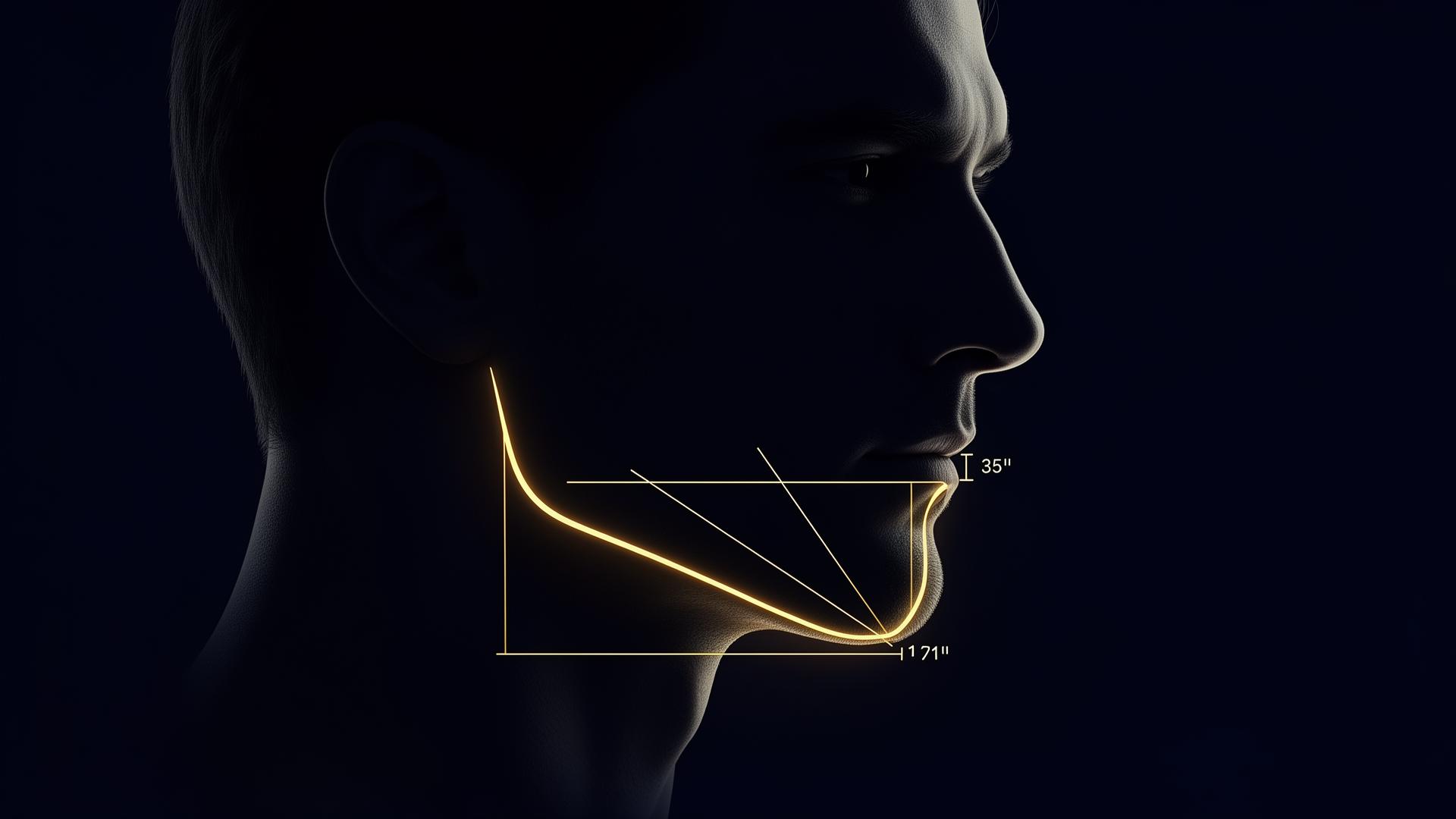
The gonial angle is formed by the vertical ramus of the jaw and by the horizontal segment of the mandible where the two meet at the bottom corner of the jaw. There are sharper lower gonial angles (110°–120°) which make the jawline sharper and are associated with higher PSL scores, more dominance, and more strength and masculinity. Males have an average gonial angle of 128°. High gonial angles (135° and above) create a rounder and softer lower third and are the most common structural failos in PSL ratings. Although they can't be surgically modified without major changes, the gonial angle can be improved with body fat changes, masseter training, and improved posture to change the overall perception at a normal social distance.
Anyone reading about PSL scoring wonders what a "weak lower third" truly means. Ultimately, when someone describes a weak lower third, they almost always mean a "high gonial angle." A high gonial angle is characterized by a jaw corner that smoothly rounds over the base as opposed to one that is sharply horizontal.
The gonial angle is one of the most misinterpreted traits in the facial aesthetics community. Some mix the gonial angle with chin projection, while others mix it with jawline width or ramus height. In this article, we'll explain exactly what the gonial angle is, why it is important, and the options that exist for gonial angle softmaxxing.
The gonial angle defined
The mandible, otherwise known as the jawbone, is separated into two sections: ramus and body. The ramus is the vertical portion, while the body is horizontal and forms the chin. The two sections meet at a corner known as the gonion.
Simply put, the gonial angle is a measurement of the gonion.
Let's say you are looking at a profile shot of a person. A jaw with a lower gonial angle (110°–120°) would create a near right angle in that corner when the ramus drops steeply and the body is horizontal. A jaw with a high gonial angle (135°+) would have a rounded corner.
Your gonial angle measurement reads your jawbone, but it alters the perception of the face in several ways.
Why gonial angle scoring impacts PSL
Due to the PSL scoring of sexual dimorphism, lower gonial angle scores are common. Unlike some other facial structures, gonial angle scoring is not a preference because of jawline aesthetic. It is a structural characteristic of masculinity. The gonial angle score is a reflection of the structural change of the gonial corner common to high testosterone exposure, and also a reflection of testosterone exposure during puberty that causes the mandible to grow. Increased testosterone impacts the growth of the ramus and the corpus of the mandible.
The community prefers gonial angle scoring because it is a structural characteristic that the community associates with masculinity, and it is a developmental change that occurs to a large extent of the community. It is a subconsciously read structural characteristic of the mandible.
Along with the jaw, gonial scoring creates three major facial characteristics:
- With a defined gonial corner, a small shadow is cast along the jaw with nearly any lighting angle. This shadow is responsible for the jawline appearing "sharp" in pictures. When the gonial scoring corner is not defined, the jaw integrates with the neck, regardless of how much body fat someone has.
- The mandibular body serves as a form of parallel to the horizontal base of the face. A horizontal base to the face approaching full parallel means a wider lower third of the face. A lower gonial angle also creates a rectangular lower face which is common for Chadlite scoring and above.
- The gonial angle defines almost everything about neck-jaw separation. A fuzzy gonial angle can destroy the line differentiation of the neck and the jaw.
Population data
Published anthropometric studies show the average male gonial angle to be around 125°–130°, with a focus on 128°. The average female gonial angle is slightly higher, usually around 130°–135°. This makes the lower face rounder, which is perceived as a more feminine feature.
What is the impact on PSL?
Based on community analysis and tiered PSL scoring, the following levels can be used as guides.
| Gonial Angle | Reference | PSL Tier |
|---|---|---|
| 104°–115° | Exceptional angularity | Chadlite floor minimum |
| 116°–122° | Strong definition | HTN+ to Chadlite range |
| 123°–128° | Angular with definition | HTN to HTN+ |
| 129°–133° | Soft definition | MTN to HTN- |
| 134°–140° | Round | MTN to LTN drag |
| 140°+ | Failo | Aggressive tier capping |
These methods of measurement are based on social distance, which is where these angles become relevant to PSL scoring.
One important point is that gonial angle cannot be looked at in isolation. A face having moderately high gonial angle (130°–133°) but low body fat with delineated masseters and good chin projection can pass for better than the angle suggests. In contrast, a face that has a low gonial angle, but has ample body fat and poor posture can potentially squander the structural advantage. The angle is the base. Everything else is built on the angle.
Interpreting gonial angles alongside other scores
Most discussions about gonial angles neglect to explain how angles factor in. They are not independent. They factor in with other categories to either exaggerate or minimize effects.
The Interaction of Gonial Angle and Body Fat. This is the most significant of all interactions. Subcutaneous fat located at the mandibular body and at the submandibular zone under the jawline will obscure the gonial angle's corner regardless of the angle of it. A male with a 118° gonial angle and 20% body fat will be rated lower in the jawline category than a male with a 125° gonial angle and 10% body fat. Body fat is the most significant controllable factor that affects the look of gonial angle.
The Interaction of Gonial Angle and Ramus Height. A long ramus tall with vertical jaw segment and a low gonial angle results in a rectangular jawline that scores at the top of the jawline category. A long ramus combined with a high gonial angle produces a tall and narrow jawline that lacks definition, often rated in the community as "horse face." Knowing the height of your ramus along with your gonial angle informs you of your lower face shape, informing which softmaxxing techniques apply to you.
Gonial Angle & Chin Projection
Strong chin projection, the forward extent of the chin relative to the face in profile, compensates for high gonial angles more than any other trait. A face with a high gonial angle but strong chin projection keeps lower third presence because the chin visually anchors the lower face, even when the jaw corners are soft. This is why many faces with objectively high gonial angles still get a high subjective chin (HTN) rating. The chin is doing significant structural work that the jaw corners cannot.
Gonial Angle & Masseter Development
The masseter muscle sits on the gonial corner, and when developed, visually widens and squares the lower face and partially compensates for a high gonial angle. This is the resulting effect of jaw training as a softmaxxing tool. It is important to note that a jaw training program is not changing the bone, but is causing the masseter to expand at the precise location where a low gonial angle would otherwise produce visible definition.
The three biggest gonial angle mistakes
Mistake 1: Gonial angle and jawline width misconceptions. These are to be measured differently. Jawline width is determined by the bigonial distance — the straight-line measurement between the two gonian points from a frontal view. A face could have a huge bigonial distance (wide jaw) but could have a high gonial angle (soft corners). The interplay between both is the visual read. Wide jaw + high gonial angle = round and wide lower face reading soft. Wide jaw + low gonial angle = the rectangular, defined lower face that scores the highest.
Mistake 2: Jaw exercises promote bone growth. The bone structure remains unchanged despite the mewing, chewing, and jaw exercises persistently undertaken. Jaw exercises are worth it because the masseter and pterygoid muscles are developed, which add more volume at the gonial region and improve how the gonial angle reads. The angle is unmovable but how it looks is definitely changeable.
Mistake 3: Spreading blame to gonial angle when the problem is actually body fat. Most people make this mistake when self-assessing. A lot of people think they have a structurally high gonial angle when really they have a low gonial angle and a lot of body fat covering it. You have to reach 10%–12% body fat first and then you can assess your gonial angle. A lot of men think that their jawline is their biggest failo, and then discover at low body fat that their gonial angle is actually pretty good, and the failos are in other areas.
The most accurate looksmax AI face rater.
PSL Rank analyzes 10+ facial categories — jawline, canthal tilt, symmetry, and more — then builds your personalized glow-up plan.
What you can actually change
The gonial angle cannot be altered without orthognathic surgery or a mandibular angle implant. These are two high-risk, high-cost interventions that are something beyond the traditional methods of softmaxxing. You can change how your gonial angle is perceived. For the majority of men, the genetic potential of their gonial angle is perceived to be lower than it actually is.
Body fat reduction — highest priority. For any man with more than 15% body fat, reducing body fat is the only softmaxxing intervention that is going to change their jaw. Before you can estimate your gonial angle, you must get to below 12% body fat as well. If you are above 10%–12% body fat, focus on nothing else. The submandibular region of the jaw is one of the later regions in the body to lose fat, so be patient.
Masseter development — next highest priority. Your best bet is mastic gum. 15–20 minutes of participation in mastic gum is good for the masseter as it does not put as much strain as traditional synthetic jaw trainers. The average man can see results in 8–12 weeks. However, your masseter does not need to be bulging. You only need enough increase in muscle for a visible change in the gonial angle. Too much hypertrophy makes the lower face dominated by the masseter.
Neck training is highly underrated. Having a thicker neck (e.g. a thicker sternocleidomastoid or muscular posterior chain) makes the jaw and neck visually separate, improving contrast and visual separation, even if the gonial angle is unchanged. Men with neck training consistently are rated 0.2 to 0.3 higher in the jawline training category than their bone structure would suggest.
Posture is highly impactful. Poor posture collapses the submental space (under the chin, jaw, and neck), making the gonial angle appear less defined, and making the jaw appear to merge into the neck. Chin tucking and dead hangs help, as do posture-related corrections. Dead hangs help posture, and are the fastest of the posture corrections with no cost.
Beard framing is situational. A beard can define the gonial region, even where the bone does not. It depends on gonial angle type. High gonial angle types: keep the beard short on the cheeks and fuller on the lower jaw and chin to help define a lower frame. Low gonial angle types: a beard is both less structurally helpful and less necessary.
Gonial angle and the PSL tier system
Jawline is one of the most examined parts of the face in the PSL tiering framework and is often compared with the assessments of facial harmony and trait symmetry. The gonial angle determines the scoring metric of the jaw and is influenced by bigonial width and chin projection.
In essence, the gonial angle is one of the greatest challenges of passing the tier system. This is particularly true for individuals with generally competitive facial traits. For example, a facial profile with solid symmetry and a strong tilt tends to receive a higher gonial angle rating, and therefore lower tier scores. This is because the gonial angle negatively impacts the scoring of the facial trait in the lower third. The community often refers to this as "falling apart below the eyes."
On the other hand, a very low gonial angle (less than 115°) results in a structural advantage and elevates the jawline score. This can occur when all other traits are average. This explains why many men with average eyes and midfaces receive higher tiers because of their jawline.
Determining the gonial angle in relation to others in the population is a way to first begin an improvement plan. Although the gonial angle is an unchangeable trait, determining the gonial angle may lead to interventions which can improve tier scores.
The most accurate looksmax AI face rater.
PSL Rank analyzes 10+ facial categories — jawline, canthal tilt, symmetry, and more — then builds your personalized glow-up plan.
Bottom line
Your gonial angle is the jaw's corner and is seen by almost everyone as they look at your face. If you have a sharp gonial angle and jaw corner, it indicates more testosterone, a better bone structure, and better genetics. However, a softer gonial angle indicates the opposite and can overshadow an otherwise good jaw.
So can you change your gonial angle? The answer is no. But it is possible to change how it is perceived. The variable with the most impact on your jawline is body fat. Beyond that, the jaw can be perceived as better through neck training and improved posture. A well-developed jaw muscle (the masseter) can also improve perception of your jawline.
To measure your real gonial angle, you are going to have to go beyond a glance in the mirror.
The most accurate looksmax AI face rater.
PSL Rank analyzes 10+ facial categories — jawline, canthal tilt, symmetry, and more — then builds your personalized glow-up plan.