How PSL Ratings Are Actually Calculated
Last updated: May 21, 2026
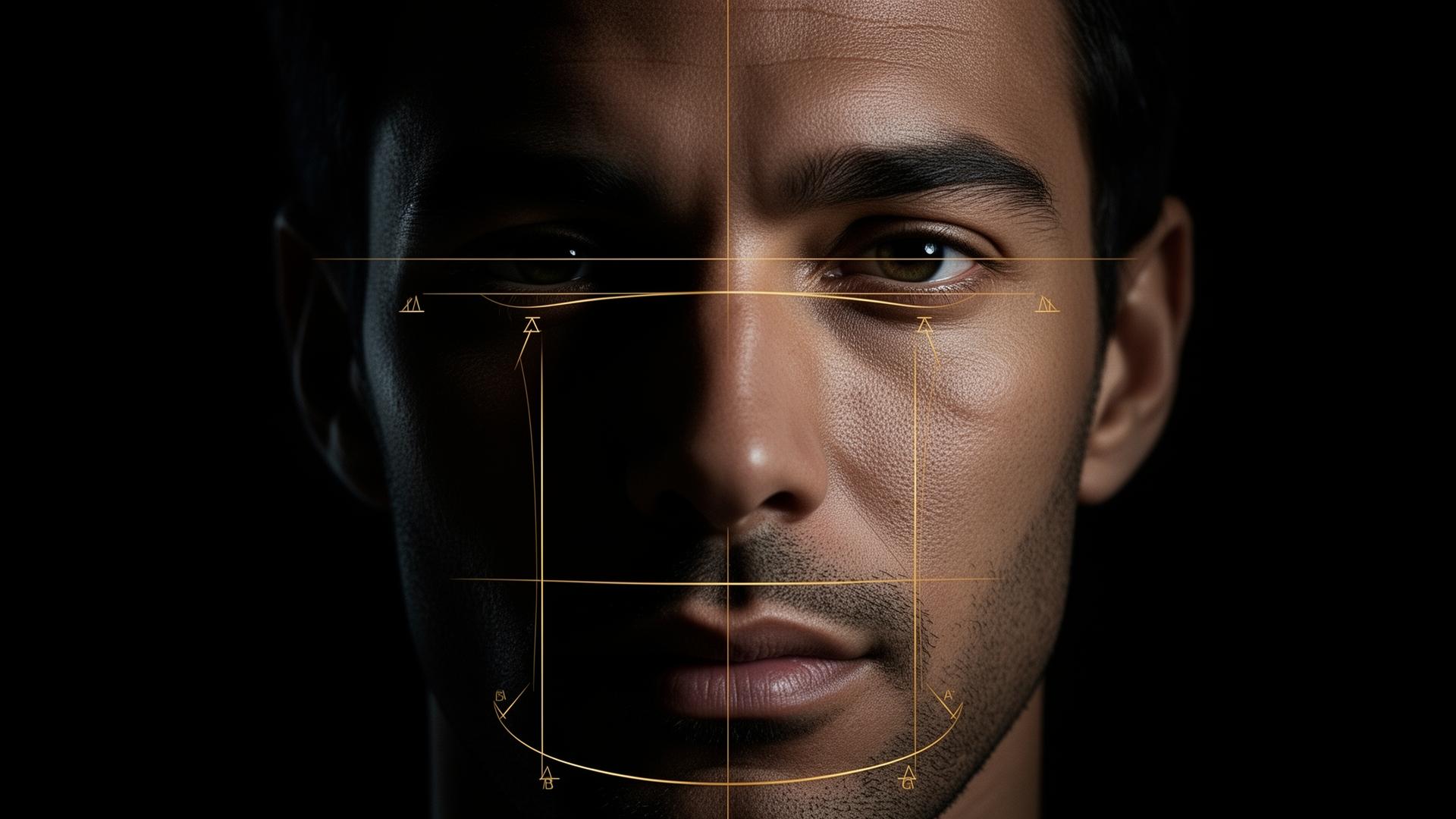
PSL ratings are far more complex than averaging scores of each category. Instead, they are weighted scores. This means scores in some regions of the face, like the eye region, jawline, and face harmony, are weighted significantly more than peripheral regions of the face such as the area surrounding the lips or skin. Therefore, face ratings in PSL can actually differ even when two faces have the same overall PSL score. This is because the PSL scoring system accounts for Halos and Failos. For example, a face that is rated highly in a single category with a notable feature and has failos in all other categories can receive the same rating as a face that has an average rating across all categories of the PSL score. It is important to note that the most efficient way to improve your score on the PSL is not to improve your weakest category, but rather to improve the categories that carry the most weight that are rated the lowest.
The typical experience of a PSL rating app user is to receive their rating, see the category scores, and go no further. Very few people ever learn or understand how the scoring truly works. This includes knowing which aspects of the scoring system carry the most weight, how their score was determined in relation to other specific components of that system, and which changes will have the most influential and meaningful impact on the overall score.
This article will provide those mechanics. It will not provide a tier list. It will not provide a definition for what HTN stands for. Rather, it will provide one with the actual logic and mechanics of the PSL rating system and how these can shape the prioritization of one's score improvement plan.
Why PSL Ratings Are Not Simple Averages
Many people assume PSL ratings work like simple averages of category scores. They assume that scoring your jawline, your eyes, your midface, etc., summing those scores, and then dividing by the number of categories yields your PSL rating.
This is incorrect, and the most important thing for you to learn about PSL ratings is that this is incorrect.
PSL ratings are not averages; they are weighted. For example, the jawline and eye area categories are weighted more heavily than the lips and nose categories. Facial harmony, which assesses how the features of the face work together, is also not an additive category. If a category has a low facial harmony score, it will not negatively affect the facial harmony score and pull that score down; it will pull the ratings of those categories down.
PSL ratings penalize failos more than they reward halos. The PSL ratings also impact more negatively from a low score on one category and less positively from a high score on one category. While this might sound illogical, this reflects how raters score categories in the community. For example, if a face has a very negative canthal tilt and a very high gonial angle, then that face would receive a much lower score than a face that does not have a good face category score and does not have any very negative ratings. This is how the PSL ratings are set up; more negative ratings receive a greater impact than positive ratings.
The distribution of scores is not uniform. Scores show a distribution where the majority occupy the mid-range between the MTN and HTN. This indicates the distinction between scoring categories is more apparent and more meaningful at the mid-range as opposed to the lower and upper extremes of the scale bound. A 4.0 and 5.0 rating on the PSL scale are a more pronounced scoring jump in contrast to the 7.5 and 8.0 rating. Visually, the difference between the lower score midpoint and a higher score maximum is less pronounced and less noticeable. Moving from the mid-range to the upper range of the scale is a more visible scoring activity than moving from the lower to the mid-range.
The categories and their respective weightings
With either community-based or AI-based PSL rating systems, the face is evaluated across a number of structural and soft-tissue categories. Not all categories are of equal weight. The following summarizes the primary categories, the weightings, and the reasons where applicable.
| Category | Weight Tier | Reason |
|---|---|---|
| Eye area (canthal tilt, shape, hooding) | Highest | First area identified, first area sustained focal point, highest sexual dimorphism area |
| Jawline (gonial angle, definition, and width) | Highest | Primary indicator of structural masculinity, lower third facial structural support |
| Facial harmony (proportional balance) | Highest | Acts as a multiplier; poor facial harmony negatively affects all categories |
| Midface (cheekbones) | High | Essential to overall facial structure, affects perceived facial width and dominance |
| Symmetry | High | Afflicts all categories of facial structural definition; a symmetrical face improves all categories |
| Skin quality | Medium-High | High visibility, perceived level of skin definition of facial structures |
| Upper third (forehead, brow ridge) | Medium | Shapes overall facial structure, less focal than upper face or lower jaw area |
| Nose | Medium | Negatively focal, when disproportionately formed; otherwise neutral |
| Lips | Low | Facial harmony contributor, not a primary influencer in PSL rating |
| Masculinity / overall dimorphism | Contextual | Composite signal of all categories |
The PSL rating is largely influenced by the eye area, jawline, and facial harmony categories. An individual face that leads well in eye area, jawline, and facial harmony can have well-developed features in all other categories, which can be peripheral. A face that leads poorly in eye area, jawline, and facial harmony cannot be well-developed in all other categories.
This is why the community believes faces are "carrying" different features. A face that "carries on the jaw" shows that a great jawline looks good by the virtue of weaker eyes or midface. A face that "carries on the eyes" shows that canthal tilt or canthal hooding is exceptional and pulls the structure above the average. Carrying in a peripheral category — great lips or skin — does not have the same impact, because those categories are not enough to lift structural weaknesses above or to a greater extent.
The most accurate looksmax AI face rater.
PSL Rank analyzes 10+ facial categories — jawline, canthal tilt, symmetry, and more — then builds your personalized glow-up plan.
What actually moves the PSL rating per point of effort
Not all improvements produce equal returns on the PSL rating. Understanding the efficiency of different interventions — how much PSL score movement you get per unit of effort — is the foundation of an intelligent ascension plan.
Tier 1 efficiency — highest return per effort
Body fat reduction (if above 12%). For any man above 12% body fat, fat reduction is the single highest-return intervention available. It affects the jawline score directly (reveals gonial angle definition, creates neck-jaw separation), the skin score (reduces puffiness, improves clarity), the eye area score (reduces periorbital swelling), and facial harmony (improves perceived facial width-to-height ratio). It costs nothing beyond time and dietary discipline. It is the only softmaxxing intervention that improves four high-weighted categories simultaneously.
Sleep optimization (if chronically under 7 hours). Chronic sleep deprivation suppresses the eye area score through persistent periorbital swelling and darkening. For men who are sleep-deprived, improving sleep quality to 7–9 hours consistently produces a visible improvement in the eye area score within two weeks. This is the second-highest return intervention for men who are not already sleeping well, because the eye area is the highest-weighted category.
Tier 2 efficiency — meaningful return, moderate effort
Skincare protocol. Skin quality is a medium-high weighted category. A basic protocol — retinoid, SPF, moisturizer, consistent cleansing — can move the skin score by 0.5 to 1.0 points over 12–16 weeks. This does not improve structural categories, but it removes a softmaxxable failo if skin quality is below average.
Haircut optimization. Hair is not a rated category in PSL scoring, but it affects the upper third score and facial harmony score through its impact on face shape perception. A haircut that adds width to a narrow face or height to a wide face shifts the perceived facial third proportions meaningfully. This is one of the fastest and cheapest interventions available.
Posture correction. Poor posture collapses the submental space under the jaw and compresses the neck-jaw separation that contributes to the jawline score. Chin tucks, dead hangs, and upper back training improve posture and, with it, how the lower third reads. Results are visible within 4–8 weeks of consistent work.
Tier 3 efficiency — real but slower return
Masseter development. Jaw training increases masseter volume at the gonial region, improving how the jawline reads at social distance. Results require 8–12 weeks minimum of consistent training with mastic gum or a jaw trainer used correctly. The improvement is real but targeted — it improves one sub-component of the jawline score, not the category as a whole.
Beard optimization. A correctly shaped beard can compensate for a high gonial angle, weak chin projection, or a soft lower third by adding visual definition where the bone does not provide it. The improvement is real and immediate. The limitation is that it is grooming-dependent — it does not improve the underlying structural score, only the perceived score in photographs and in person.
Tier 4 — low efficiency for most men
Improving already-above-average categories. If your eye area is already rated HTN, improving it further produces diminishing returns on the overall PSL rating. The score ceiling in any single category contributes less and less to the overall rating as you approach that category's ceiling. Resources spent improving an already-strong category are almost always better spent on a below-average category in a higher-weighted tier.
The biggest rating traps
Trap 1: Optimizing peripheral categories as a priority. The most common mistake in personal categorization elevation is the focus on peripheral categories; this includes routines for skin, lips, and eyebrows, and ignoring the categories with the highest weight, such as the body's structural categories. Peripheral improvements are the most visible and quickest to be perceived as progress. They are also the lowest return on the PSL rating calculation. A flawless skin care routine on a face with a significant eye area failo produces a fraction of rating improvement worked on body sleep, body fat, and body posture.
Trap 2: Setting the PSL rating as the target. Rather, the PSL rating is not the target, but the means to the end. The PSL is a diagnostic tool whose function is to show the categories in which the overall score is low and the possible measures to correct them. In the absence of the category breakdown, the overall score is not interpreted, and therefore, it does not serve to signal improvement.
Trap 3: Using your PSL rating to compare with others' ratings in other category calibration systems. Rating within the PSL framework is the least common denominator across the apps and communities. A 5.5 rating on one level may translate to a 6.2 rating on another level, and so on. What counts is your rating movement within one tool over a period, not the rating in other systems or the absolute value of the rating.
Most people do not fully utilize the trap that ignoring your gaps presents. The gap between your current PSL rating and your potential score is the most useful piece of information that a rating provides. A large gap suggests a potential improvement area, while a small gap suggests that you have hit your ceiling, and to further improve you have to either choose to accept the ceiling or improve by a step further. Most men, when challenged on their large gaps, offer body fat, sleep, or posture management — the three highest-return softmaxxing interventions — before concluding that they have hit their ceiling.
The most accurate looksmax AI face rater.
PSL Rank analyzes 10+ facial categories — jawline, canthal tilt, symmetry, and more — then builds your personalized glow-up plan.
Rater AI vs. human rater's PSL scores
There are a few important differences between human community rating and AI-based PSL Rater score. Knowing and understanding these differences is how you should interpret your score.
Human community rating is very inconsistent. The same face is rated by ten different community members and produces a range of scores that is, in most instances, a spread of 1.0 to 1.5 PSL points. Raters have different preferences, and are influenced by factors not related to facial features. They may be influenced by quality of the photo, perceived ethnicity of the subject, etc. Human community rating may provide useful social calibration, but may not serve well for diagnostics.
AI raters show dependability that hinges on the degree of calibration. An AI rating model eliminates the noise of human inconsistency and will rate the same face the same way every time. However, the rating quality directly depends on how well the model learned community consensus during the calibration. When AI models are well calibrated and are trained on large datasets of community-consensus ratings, those AI models can be used to create highly reliable category-level diagnostics that surpass any single human rater. This is possible because of the consistent weighting that those models bring to the rating of every face.
At a structural level, AI can help much more than humans with category-level precision ratings. However, AI models fall short of humans when expressing overall impressions of faces or holistic "gestalt". Human raters, with experience, are more sensitive to the overall impressions that a face can give. This "just looks good" phenomenon is extremely difficult for AI to gauge than for a human raters.
AI is more sensitive than human raters to the conditions of a picture, such as lighting and angle. With experience, human raters are better able to subtract distortion from a picture. AI models are not as good at adjusting conditions, perception-wise, that are obvious with a photo. Thus, reliable AI ratings depend on how a photo is taken more than most users expect.
As you execute your ascension plan
PSL rating calculations involve a methodology most people don't tend to incorporate in their ascension planning.
Step 1: Pull a complete category-level breakdown, rather than just an overall score. Your overall PSL rating tells you your position. The category scores tell you your rationale. Without this breakdown, your feasible options for rating improvement remain unidentifiable.
Step 2: Start by determining your highest-weighted failos. Your below-average category scores now need to be organized by their weight tier. Eye area and jawline failos should be corrected prior to midface failos, which come before the peripheral failos. Most people tend to do the opposite — prioritizing their fixes based on what's most visible, what can be fixed most quickly, and what's least costly.
Step 3: Determine which failos are softmaxxable. An average below a gonial angle with masseter muscles at 10% body fat indicates a structural failo with no softmaxxing runway. A below-average gonial angle score at 18% body fat indicates a softmaxxable failo (the balanced structure is being obscured by body fat and is not scored to be definitive). These two cases elicit completely different responses.
Step 4: Assess the delta on rescans, not the absolute score. What matters in a PSL is not the absolute score, but the delta on the score across rescans by category. An improvement of score by 0.3 points in the eye area after 8 weeks of sleep optimization indicates improvement. A score that remained constant in the eye area after 8 weeks indicates that something else is suppressing that category. The rescan delta is the answer. The absolute score is the background.
The most accurate looksmax AI face rater.
PSL Rank analyzes 10+ facial categories — jawline, canthal tilt, symmetry, and more — then builds your personalized glow-up plan.
In conclusion
PSL ratings are weighted, asymmetric, IT dependent. Eye area and jawline categories score more than all others. Failos in high-weighted categories are more effective than halos in the same categories. Two individuals can present two completely different looks, but can have the same PSL score.
The optimal path is to determine the category with highest weight and lowest average score, and then determine and address the failos in that category. For most men, the answer is body fat, sleep, and posture. They are not glamorous changes, but they are changes in the highest-weighted categories, and they have no negative effects. Your PSL rating is your map to improvement. Your category breakdown is a legend to your map.